How To Tell If Anode Rod Is Bad
If you lot know nigh anode rods, and then you know that they call for to live replaced. After all, a lot rides on replacing this i function if yous value the longevity of your H2O heater! On average, they ask to be changed every three-5 years. But amongst a 2-yr range the fact that close to H2O qualities make the rods degrade faster in addition to it can be difficult to know when precisely to modify this all-as well-important part
There are plenty of ways to enjoin that your anode rod needs replacing. The about straightforward bank check is just to do a visual inspection. However, in that location are other signs y'all may accept noticed that y'all might non take known could be indicators of a rod gone bad.


Orange/brown water, air inward the pipes, suddenly smelly H2O, or a banging sound from the H2O heater betoken a bad anode rod. Keeping a tape tin assist signal when the anode rod will live going bad. Visual inspections are very reliable. In severe cases, a leaking tank will demonstrate the anode is bad.
Keep a Record of Changes
Keeping a tape of when you lot replace your anode rod tin assistance y'all to approximate when the rod will side by side take replacement without needing to bank check it all the time.
You can too “go to know” your H2O heater. If your H2O origin too water heater do not alter, and so you tin unremarkably quite accurately predict when adjacent the anode rod requires replacement.
For instance, if y'all know that the by two times, you lot needed to change the anode rod afterwards around four or iv.5 years, so the chances are that you volition only necessitate to change it once more inward four or iv.v years.
How Often Must Anode Rods Be Changed?
The average anode rod will exclusively ask replacement every three-five years. However, at that place are many variables that can increment or decrease the lifespan of a rod.
One of those variables is water hardness. Naturally, hard in addition to soft water are relatively equal when it comes to the rate of corrosion, assuming yous function the right type of anode rod.
However, if yous role a H2O softener, your anode rod will involve rattling frequent replacement.
This is because H2O softeners supersede the minerals in difficult water amongst sodium. While this does, of form, soften the H2O together with cut back the buildup of limescale, the sodium volition greatly increment the rate of corrosion equally a tradeoff.
This may atomic number 82 to an anode rod needing replacement every 1-two years, though this could really live fifty-fifty more than frequent if your H2O is existence over-softened.
Because water softening causes such a large increase inward the speed of corrosion, it is recommended to upward inspections, fifty-fifty checking it equally often as every six months.
Visual Inspection
It should live relatively easy to enjoin when an anode rod has gone bad simply through visual observation.
Once an anode begins to corrode, it will get to alter color in addition to texture. Rather than a shiny argent, its surface volition get down to take on a coppery brownish color.
Additionally, the rod’sec smoothen surface will begin to educate a crude as well as porous texture, well-nigh similar a cross between sandpaper and a sponge.
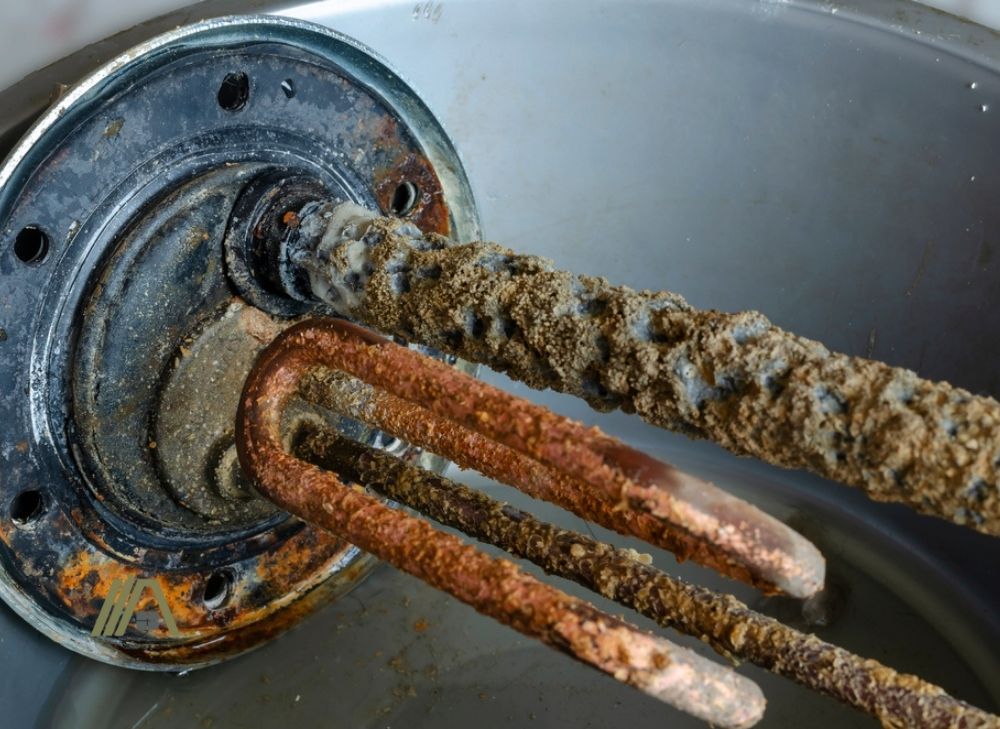
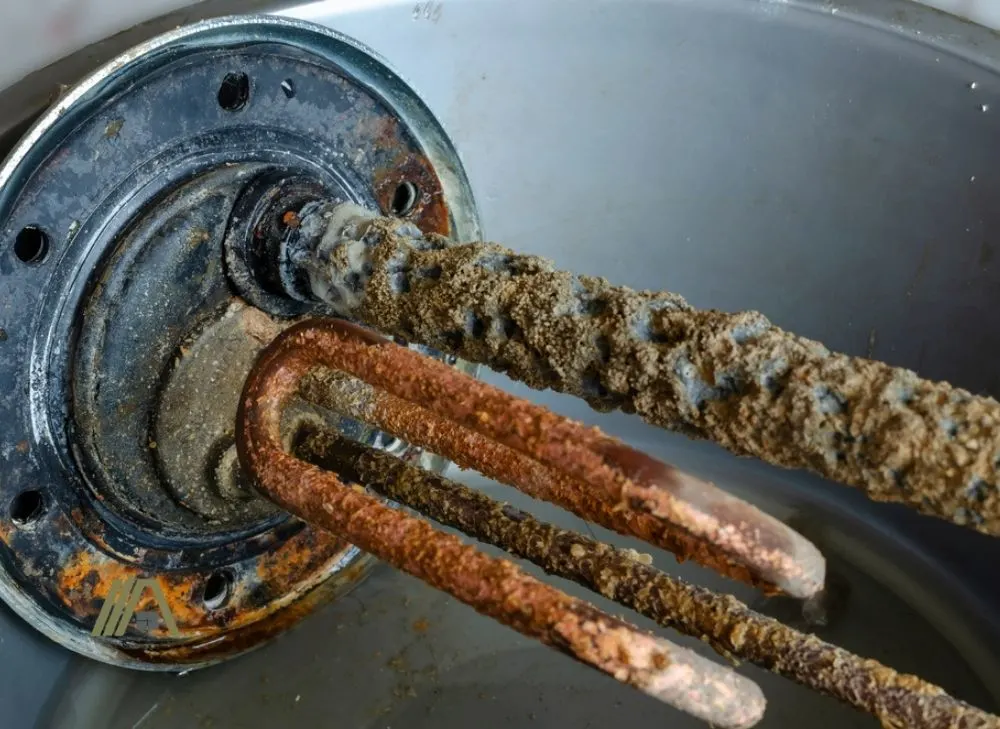
Lastly, the rod volition set about to thin equally its cloth begins to corrode away.
If your rod has noticeably thinned on acme of developing a rusty appearance, it may call for changing. Measure your rod; if it is solely ½” inwards diameter or less, it should live changed.
If you are able to run into its sparse steel heart at any betoken along its length, or if it is coated in a white calcium heart, it has definitely gone “bad” in addition to needs replacement before it breaks off or your tank begins corroding instead.
How to Check Your Anode Rod
Anode rod removal is somewhat universal, though in that location may live slight differences betwixt models, or if y'all accept complications similar a seized anode.
Generally, however, you will follow these steps:
- Disconnect the power (electrical heater) or gas (gas heater) to your H2O heater.
- Close the chief H2O furnish or the common cold H2O inlet.
- Connect a hose to as well as drain the H2O out of your heater. (Use caution, this water volition be rattling hot!).
- Locate in addition to loosen the hex head bolt on elevation of your heater. Various tools like a piping wrench, a breaker bar, or an touch driver may be needed.
- Pull out the anode to inspect. Reinstall the rod if it appears fine, or supplant it amongst a new rod if it appears worn.
Water Smells Like Rotten Egg
If y'all’ve been noticing that your water smells similar rotten eggs, it’s possible that the job is related to your anode.
This stinky olfactory property power remind y'all of sulfur—because it is! To be more than specific, the odour is caused by hydrogen sulfide gas. There are 2 chief ways this gas tin go a problem inward your H2O.
Some H2O supplies, particularly untreated H2O supplies similar good water, comprise high amounts of an ion called sulfate. This sulfate is turned into hydrogen sulfide gas in one case broken down by sulfur-reducing bacteria.
Alternatively, your anode rod has corroded. Due to corrosion, the metals (aluminum in addition to magnesium) used for anodes tin can react amongst the sulfates in the water to make hydrogen sulfide gas.
Essentially, it can’t hurt to check on your rod’s condition if y'all’re smelling sulfur. Either your rod is corroded and needs replacement, or yous should await into getting a unlike type of rod altogether.
Are You Using the Correct Anode Rod?
While smelly water tin can sometimes be corrected with anode replacement, there are other ways to forbid its occurrence.
First as well as firstly, ensure yous are using the correct type of rod for your water. While magnesium rods are excellently suited to softened H2O and aluminum rods are perfect for harder H2O, neither are the right rod for smelly water.
In these cases, you lot should view choosing to install a zinc alloy sacrificial anode rod or a powered anode rod instead.
Both zinc anodes together with powered anodes destroy sulfur-reducing bacteria.
If you lot are already using a zinc alloy anode as well as the scent returns, it is a skilful indication that the metallic has been depleted as well as it’second time for a novel rod.
Hot Faucets Splutter (Air inwards the Pipes)
If your common cold water is running without a job, merely your hot H2O splutters too pours out of the faucet inconsistently, and then you lot’ve got air inwards your hot water line of work.
This air is hydrogen gas, which is created through the reaction of sure cloth in the water amongst the metallic of the anode rod.
This is more likely to happen inward well water, which is frequently untreated, too if the anode rod is magnesium. This is because magnesium is the virtually reactive cloth used for sacrificial anodes. However, it may notwithstanding hap amongst aluminum rods.
There are many potential fixes to this upshot. Like with smelly H2O, i of those potential solutions could be the close monitoring of in addition to replacement of anodes before they are severely worn out in addition to able to contribute to excessive hydrogen gas production.
Alternatively, swapping to a powered anode can in one case again live a more permanent solution. This is because a powered rod is made of titanium, a metal with extremely depression reactivity.
As powered anodes are non-sacrificial as well as designed for long-term use, they will foreclose hydrogen gas buildup from corrosion likewise.
Brown Tint to Hot Water
If yous’re noticing that entirely your hot H2O has an orangey or chocolate-brown discoloration, then your anode rod is likely to live past its due appointment.
This dark-brown tint is normally caused past rust or sediments inside the H2O tank. Anode rods by and large prevent the majority of this buildup past attracting corrosive elements to themselves.
If your rod has worn out, your tank becomes the side by side “victim.” Any loose rust buildup too debris will observe its way into your water lines, creating the brown colour.
If you lot are noticing that it is not but your hot H2O that is discolored, or if your discoloration is a colour other than a rusty brownish, and then yous have a dissimilar job. It is likely your H2O supply itself that is the effect, non simply your anode or your H2O heater.
Banging Sound From Inside Tank
Banging noises from inside the tank are nonetheless another indication that your rod has failed in addition to needs replacement.
There are of grade several potential causes of banging or popping noises, close to of them harmless. However, If it distinctly sounds like something is knocking against the inside of your H2O heater or rattling within it, and then that’second in all probability precisely what’s happening.
That racket is likely your anode rod itself, or maybe multiple pieces of it, that accept broken off and are floating freely inside the tank.
This happens when your anode has corroded too much without replacement, creating thin weak points at which it is prone to separation.
It is up to you lot to decide how to handle these broken pieces; whether they are fished out, broken up until they are pocket-sized plenty to be flushed, or even but left inward the tank.
Any of these options are viable, only note that if yous get out your broken anode inside the tank, yous may keep to take heed it make noise until it has fully deteriorated.
Water Heater Has a Tank Leak
Of all the indicators of a depleted anode rod, a leaking water heater tank may be the least desirable.
It’second important to kickoff check on your rod if your tank is leaking. If it is completely depleted, then it becomes more than likely that your tank has rusted through from the within together with you call for to get a novel water heater altogether.
Don’t fret likewise early on, though! It is possible for a leaking tank to live caused past other, less severe issues, though a cook will nonetheless be necessary, together with mayhap fifty-fifty a replacement.
For example, your tank could be leaking at the drain valve, or the inlet together with outlet connections. In this case, it’s probable simply loosening over fourth dimension that has created a leak together with can live quickly fixed.
Other leaks could be caused by the internal lining (if your tank has one) corking, or quondam historic period together with gradual habiliment in conclusion catching upward to the heater despite the presence of an anode. Leaks caused past reasons like this will still postulate full water heater replacement, fifty-fifty if non caused past the anode.
Sources
https://www.applewoodfixit.com/web log/anode-rod-water-heaters-hole-and-corner-weapon/
https://anyhourservices.com/weblog?mail=water-heater-maintenance-anode-rod
https://www.artdouglasplumbing.com/what-should-yous-make-if-you lot-have-brown-water
https://bosworthco.com/dealing-alongside-brown-water/
https://www.corroprotec.com/web log/air-inward-hot-H2O-occupation/
https://www.corroprotec.com/blog/sulfur-scent-inward-hot-water/
https://www.masterwater.com/hydrogen-sulfide/
https://www.plumbingplus.net/web log/2017/september/maintaining-your-tank-type-H2O-heater/
https://www.plumbingsupply.com/understanding-water-heater-anode-rods.html
https://sandiegoplumbingandpipelining.com/how-to-order-if-anode-rod-is-bad/
https://theinfinitekitchen.com/faq/question-what-causes-rust-color-in-hot-H2O/
https://thomasgalbraith.com/noesis-center/H2O-heater-leaks-cincinnati/
https://thorntonandgrooms.com/aid-guides/why-does-my-water-heater-smell-similar-rotten-eggs
Comments
Post a Comment